Have you ever generated an image with an AI tool like Midjourney, DALL-E, or Stable Diffusion that felt… flat? The subject was right, the lighting was okay, but the image lacked drama, emotion, or a sense of scale.
The missing ingredient usually isn't a more complex subject; it's the camera angle.
In the world of AI prompting, specific cinematic terminology acts as a cheat code. The models are trained on professional photography and film concepts. If you speak their language, you get better results.
Enter the "Google Nano Banana Camera Angles" list. Despite the hilarious name (and the obsession with bananas as subjects), this chart is actually a goldmine of standard, professional cinematography definitions.
Let’s break down this complete list and learn how to stop creating generic images and start directing visual stories.
Why "Nano Banana"? 🍌
Don't let the name fool you. While the examples are fruity, the terminology is industry-standard. Whether you are photographing a person, a building, or yes, a banana, these angles dictate how the viewer feels about the subject.
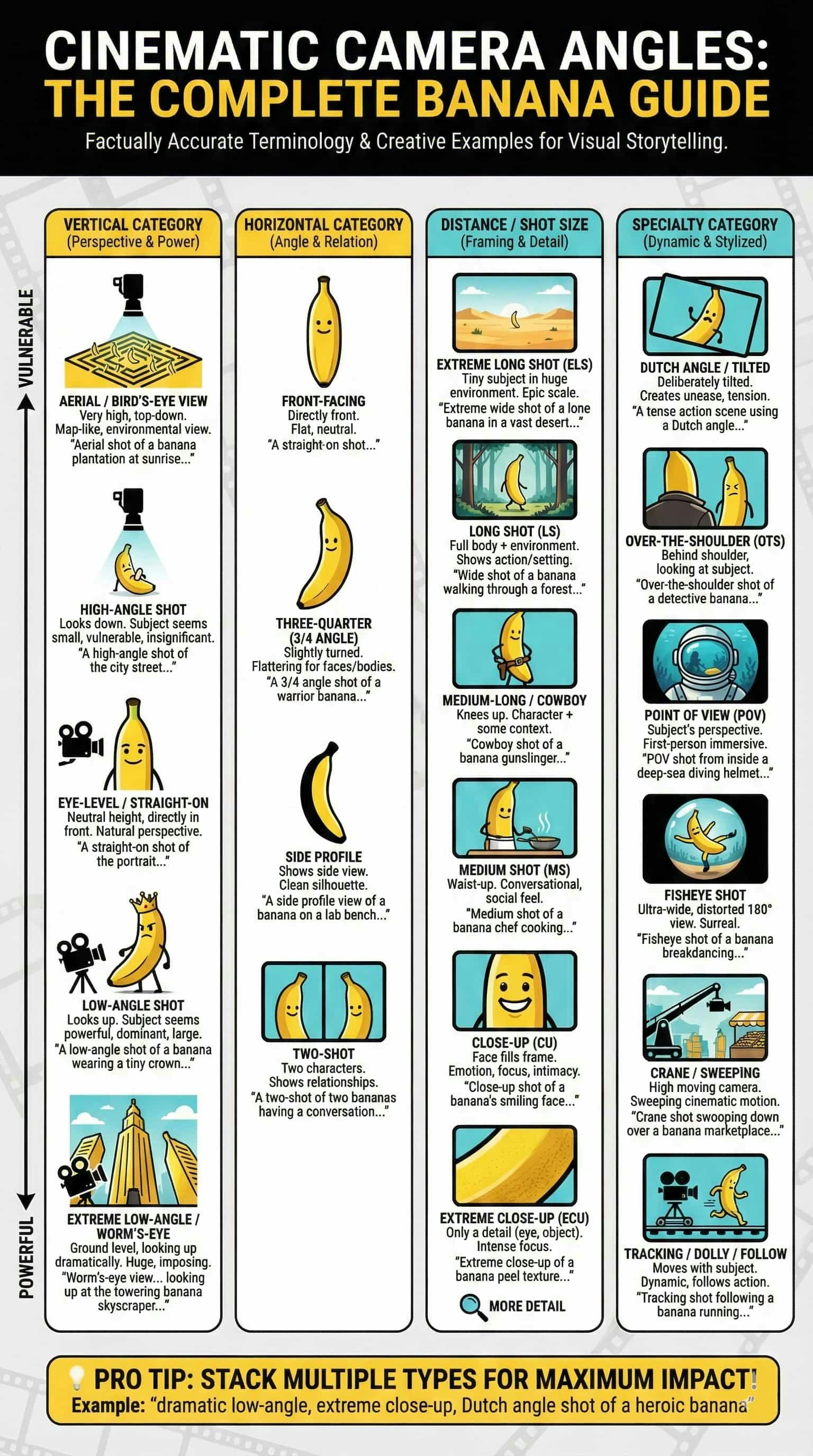
By mastering these four categories, you gain full control over your AI director's camera.
Category 1: Vertical Angles (The Power Dynamics) ↕️
Vertical angles are all about height relative to the subject. They subconsciously tell the viewer who is in charge in the scene.
The Power Trip: Looking Up
When the camera is low, looking up, the subject appears larger than life.
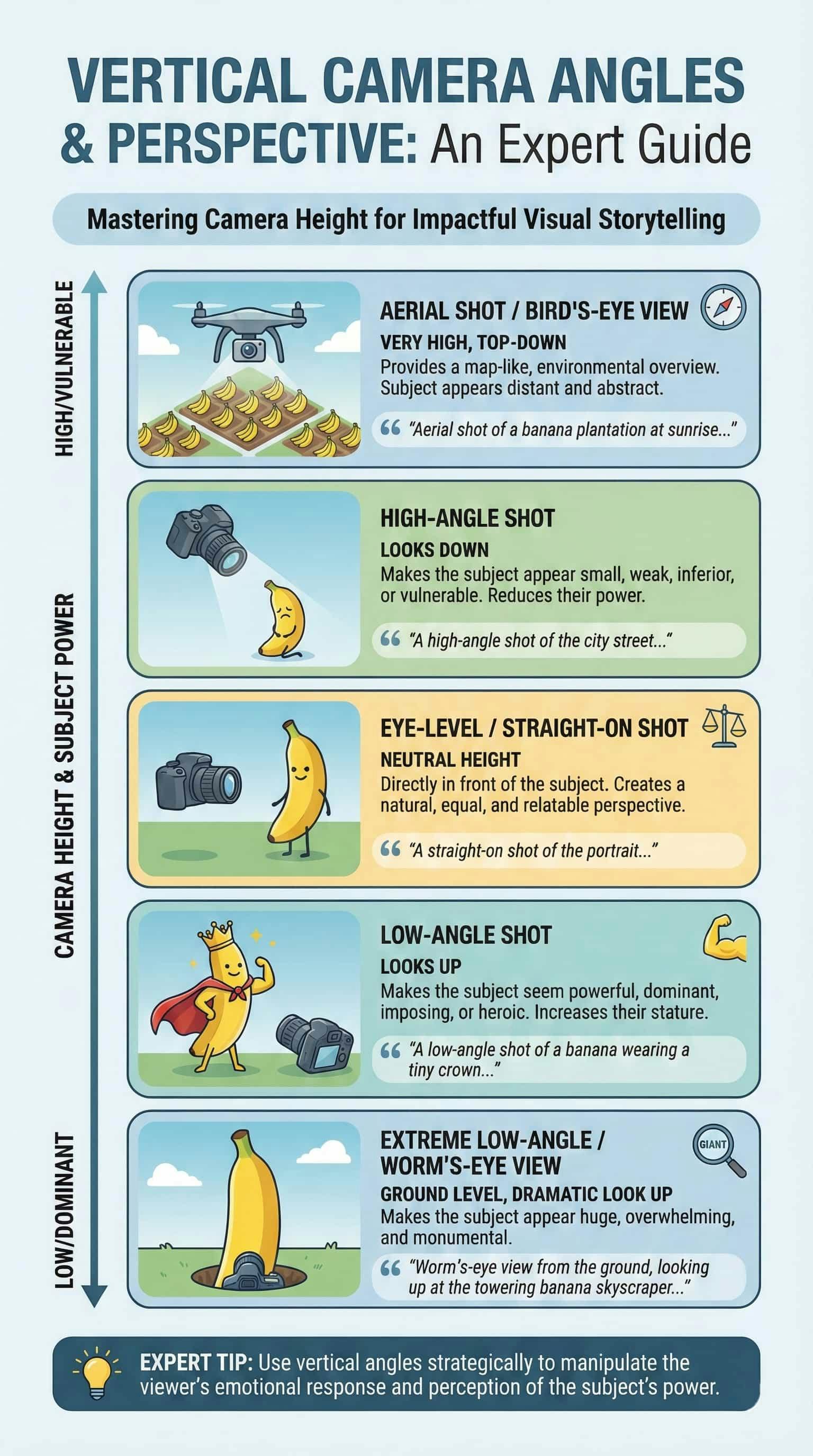
- Low-angle shot: The camera looks up at the subject. This immediately makes the subject seem powerful, dominant, or heroic.
- Prompt Idea: "A low-angle shot of a banana wearing a tiny crown, looking heroic."
- Extreme low-angle / Worm's-eye view: The camera is practically on the floor. This creates massive scale and drama. The subject becomes imposing, even threatening.
The Vulnerable Position: Looking Down
When the camera is high, looking down, the subject appears diminished.
- High-angle shot: The camera looks down on the subject. This makes them look small, vulnerable, weak, or insignificant.
- Prompt Idea: "A high-angle shot of a lone banana in the middle of a busy city street."
The God View: From Above
- Bird's-eye view / Top-down view: Directly overhead looking straight down. This flattens the image and is great for graphic, map-like perspectives or showing layouts.
- Aerial shot: Used for massive environments, usually implying a drone or helicopter view.
Category 2: Horizontal Angles (The Connection) ↔️
This category defines where the camera is placed around the subject on a horizontal plane. It dictates how intimate or detached the viewer feels.
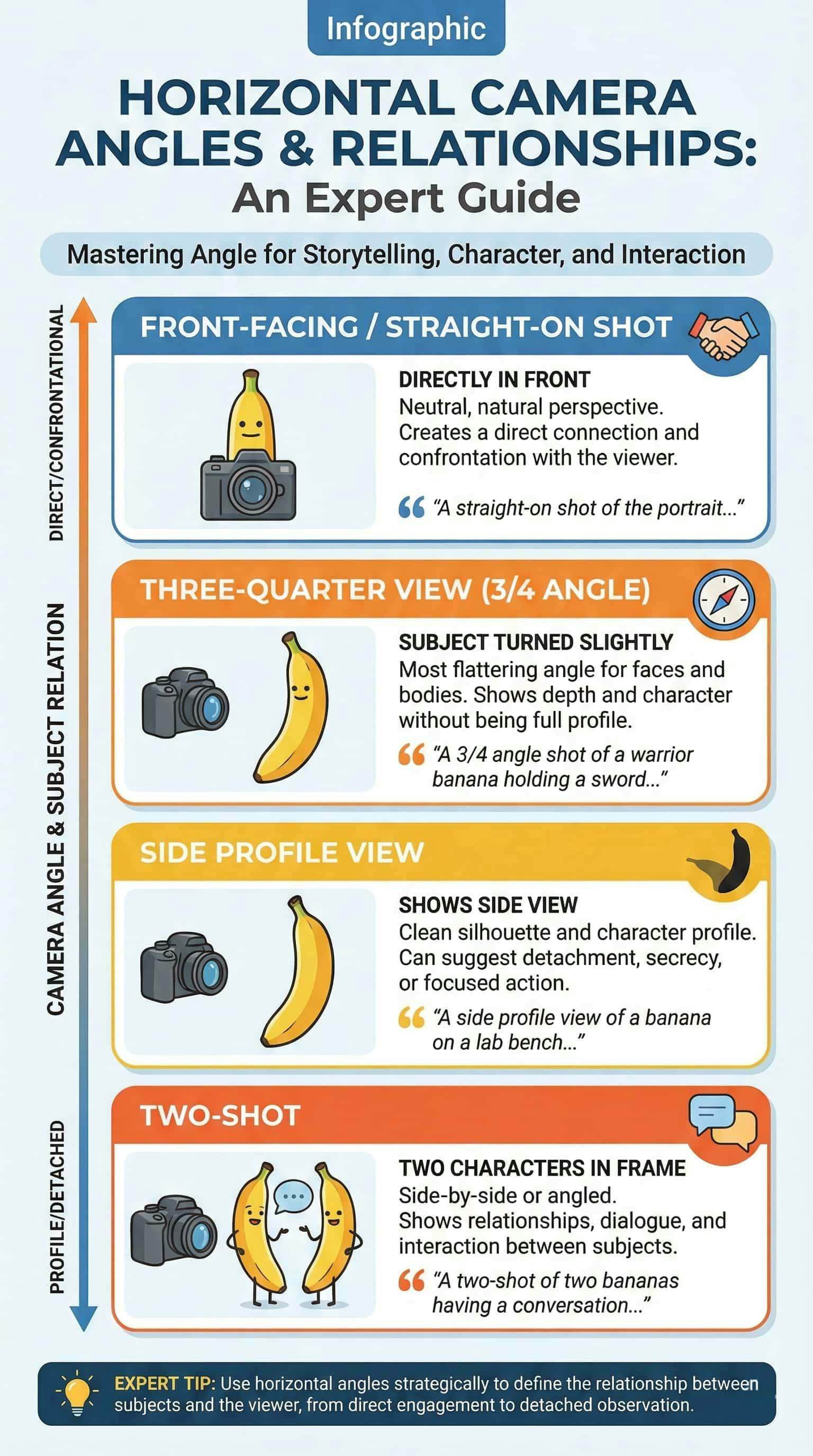
- Front-facing / Straight-on shot / Eye-level: The most neutral angle. It feels natural and honest, like you are having a conversation with the subject.
- Three-quarter view (3/4 angle): The subject is turned slightly away from the camera. In portrait photography, this is often considered the most flattering angle because it highlights facial contours better than a flat, straight-on shot.
- Prompt Idea: "A 3/4 angle shot of a warrior banana holding a sword."
- Side profile view: Shows the subject perfectly from the side. It creates a clean silhouette and can feel slightly detached or analytical.
- Two-shot: A framing term indicating two characters are in the shot together. It’s essential for establishing relationships or dialogue between subjects.
Category 3: Distance and Shot Size (Framing the Story) 🖼️
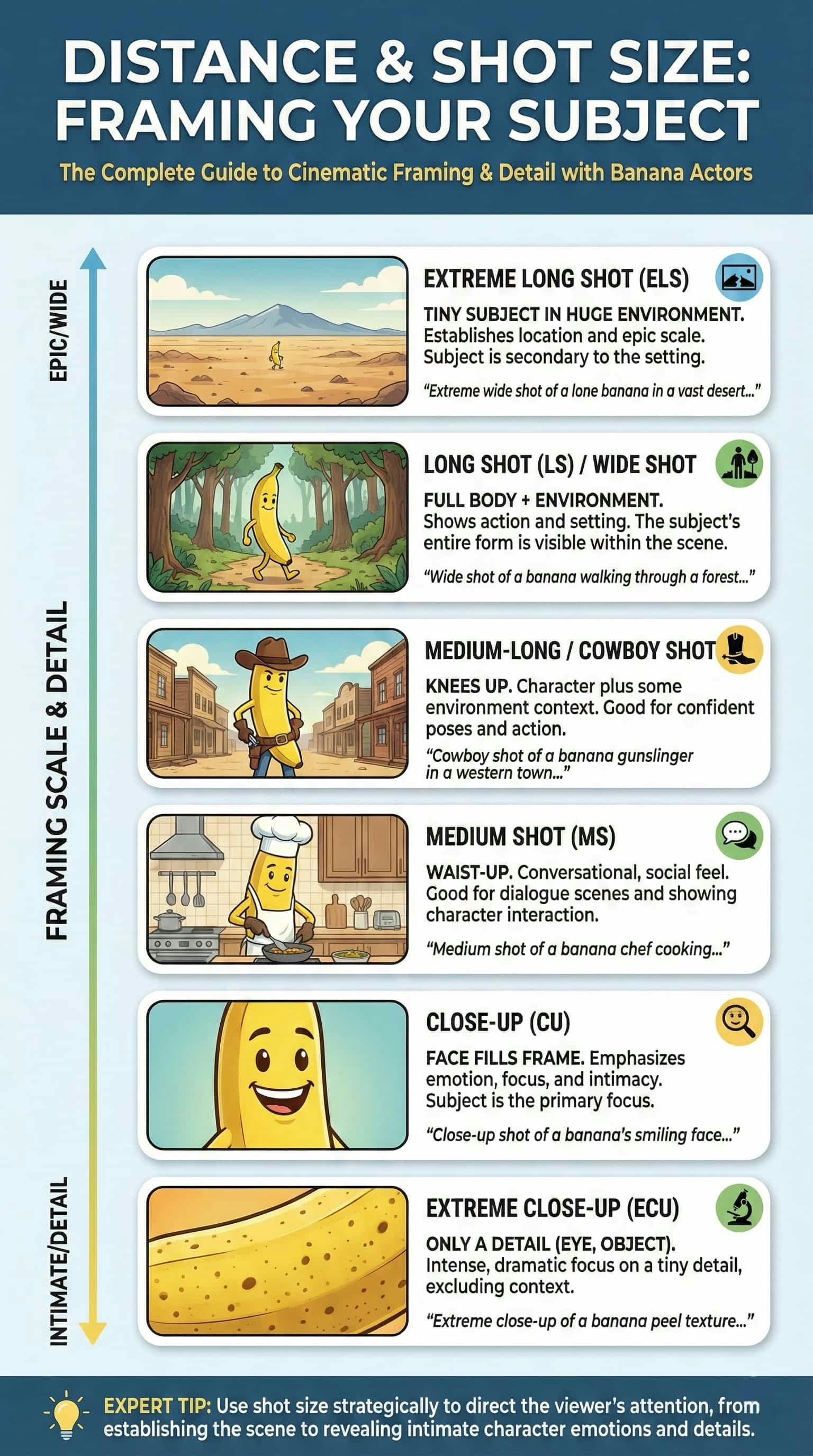
How close are we to the action? Distance tells us how much environmental context we should see versus emotional detail.
Getting Up Close (Emotion & Detail)
- Extreme close-up (ECU): Intense and dramatic. It focuses on a single detail—an eye, a hand, or a texture—filling the frame completely.
- Prompt Idea: "Extreme close-up of a banana peel texture, gritty detail."
- Close-up: The main subject (usually a face) fills the frame. This is the go-to shot for showing emotion and creating intimacy.
The Middle Ground (Action & Context)
- Medium shot: Usually waist-up. It’s great for showing body language while still feeling conversational.
- Medium-long / Cowboy shot: A classic cinematic term (from Westerns, designed to show the gun holster). It frames the subject from mid-thigh or knees up. It shows character and their immediate surroundings.
Stepping Back (Scale & Setting)
- Long shot / Wide shot: The full body of the subject is visible, but the environment dominates the frame. It establishes where the action is happening.
- Extreme long shot / Extreme wide shot: The subject is tiny; the environment is massive. This conveys epic scale, isolation, or grandeur.
- Prompt Idea: "Extreme wide shot of a lone banana in a vast desert at sunset."
Category 4: Specialty Angles (Mood & Movement) 🎬
These are stylized shots used to evoke specific feelings or imply camera movement.
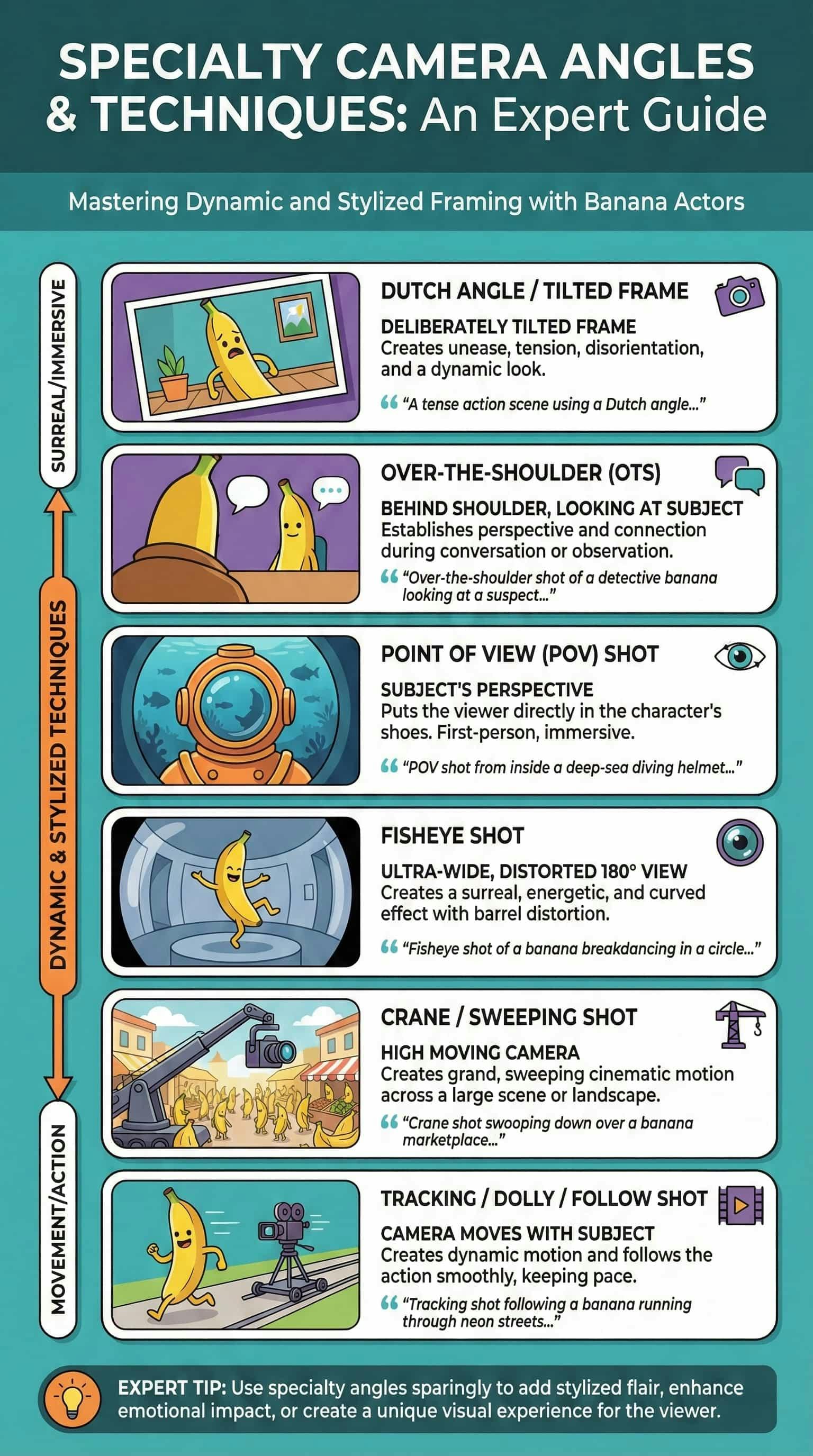
- Dutch angle / Tilted frame: The camera is deliberately tilted sideways so the horizon is not level. This immediately creates a feeling of unease, tension, disorientation, or chaos.
- Prompt Idea: "A tense action scene using a Dutch angle..."
- Over-the-shoulder shot (OTS): We look over one character's shoulder at another subject. It places the viewer inside the conversation.
- Point of view (POV) shot: We see exactly through the character's eyes. It is highly immersive.
- Fisheye shot: Uses a specialized lens for an ultra-wide, distorted, 180-degree view. It feels surreal, energetic, or cramped.
- Moving Shots (Crane, Tracking, Dolly): While AI generates still images, using terms like "sweeping crane shot" or "dynamic tracking shot" tells the AI to add motion blur or compositional elements that imply movement.
The "Nano Banana" Pro-Tip: Stack Them! 🥞
If you take one thing away from this guide, it should be this tip at the bottom of the chart: Stack multiple types for maximum impact.
Don't just ask for a "banana." Ask for a scene with specific directorial intent.
Weak Prompt:
"A picture of a banana hero."
Strong "Nano Banana" Prompt:
"A dramatic low-angle, medium shot of a heroic banana, Dutch angle to add tension, golden hour lighting."
By combining a vertical angle (low-angle for power), a shot size (medium shot for context), and a specialty angle (Dutch angle for drama), you move from asking for a noun to asking for a vibe.
Go forth and direct your AI masterpieces! 📷🍌
Resources & Stack 🛠️