How Much Does It Cost to Build a Custom App with Frappe Framework?

A practical breakdown of scope, delivery models, and lifecycle costs for custom Frappe applications.
A founder opens a fresh spreadsheet, types "Frappe developer cost," and finds twelve blog posts about ERPNext modules and zero straight answers. Every agency wants a discovery call before quoting anything, and the launch deadline hasn't moved.
This post fills that gap: a grounded, tier-based way to think about what a custom app development project on Frappe Framework actually costs to build — plus hiring rates, DIY vs freelancer vs agency trade-offs, and red flags, so you walk into that call already knowing what a fair number looks like.
~10 minutes
Founders and product managers budgeting a Frappe project, agencies scoping quotes, and developers deciding whether to specialize in Frappe. 🚀
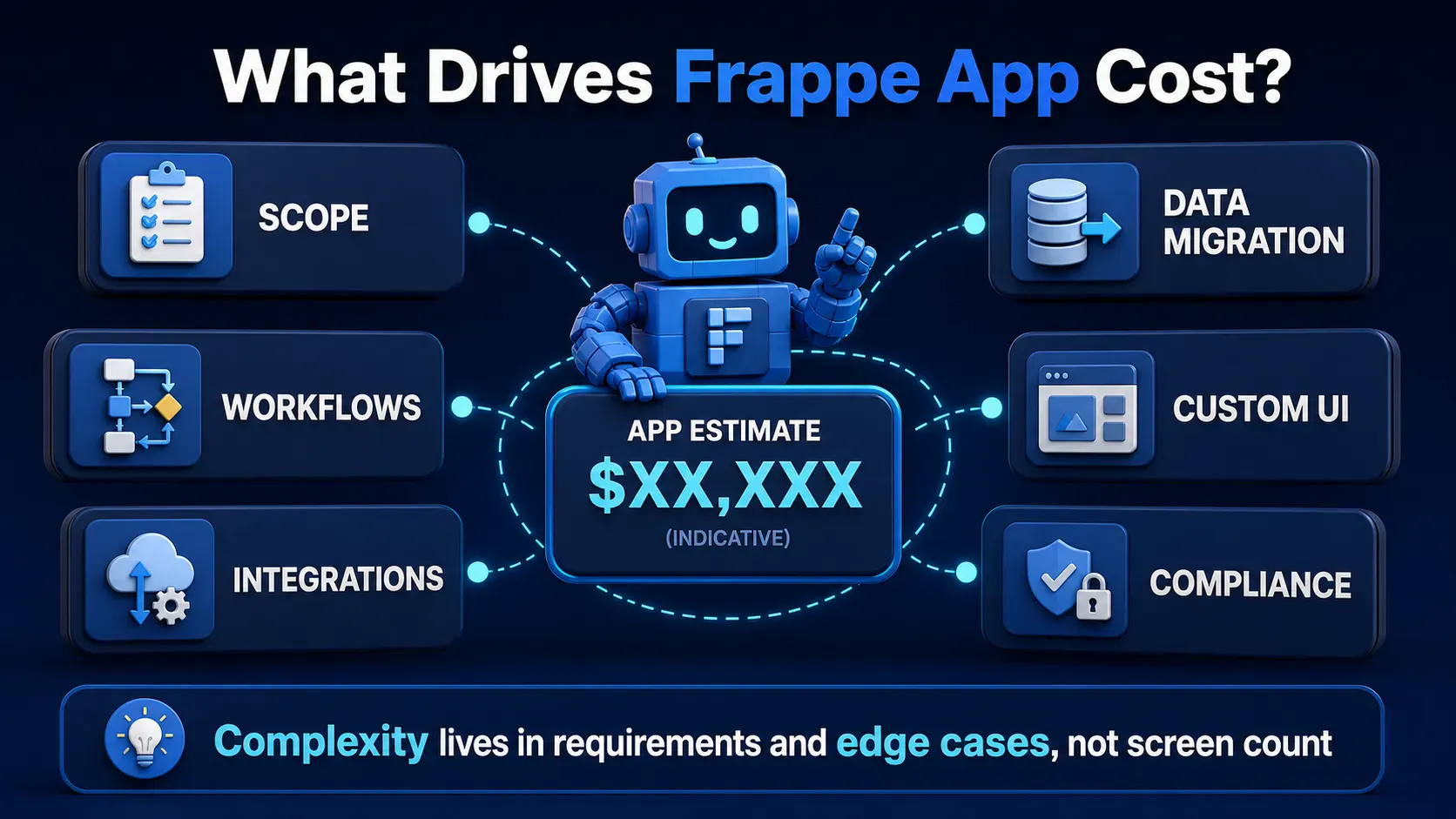
Workflows, integrations, migration, UI, and compliance usually matter more than the number of screens.
Strip away the jargon and a Frappe project's price comes down to how much custom logic 🧩 you're asking for versus how much you can get from configuration alone.
Frappe's core unit is the DocType 📋 — a low-code way to define a data model that automatically gets a database table, a form UI, list views, permissions, and a REST API with no extra plumbing. That single feature is why Frappe projects frequently cost less to build than the same app in a from-scratch framework: hours that would go into writing CRUD screens, an admin panel, and API boilerplate are simply not needed.
The cost that remains is almost entirely about how far you push past what DocTypes give you for free — custom Python business logic, complex workflows, third-party integrations, and UI polish beyond Frappe's default Desk interface.
💡 Pro Tip: Before any quote conversation, list every screen and workflow your app needs and mark each one "standard DocType" or "custom logic required." That single exercise predicts your budget tier better than almost anything else.
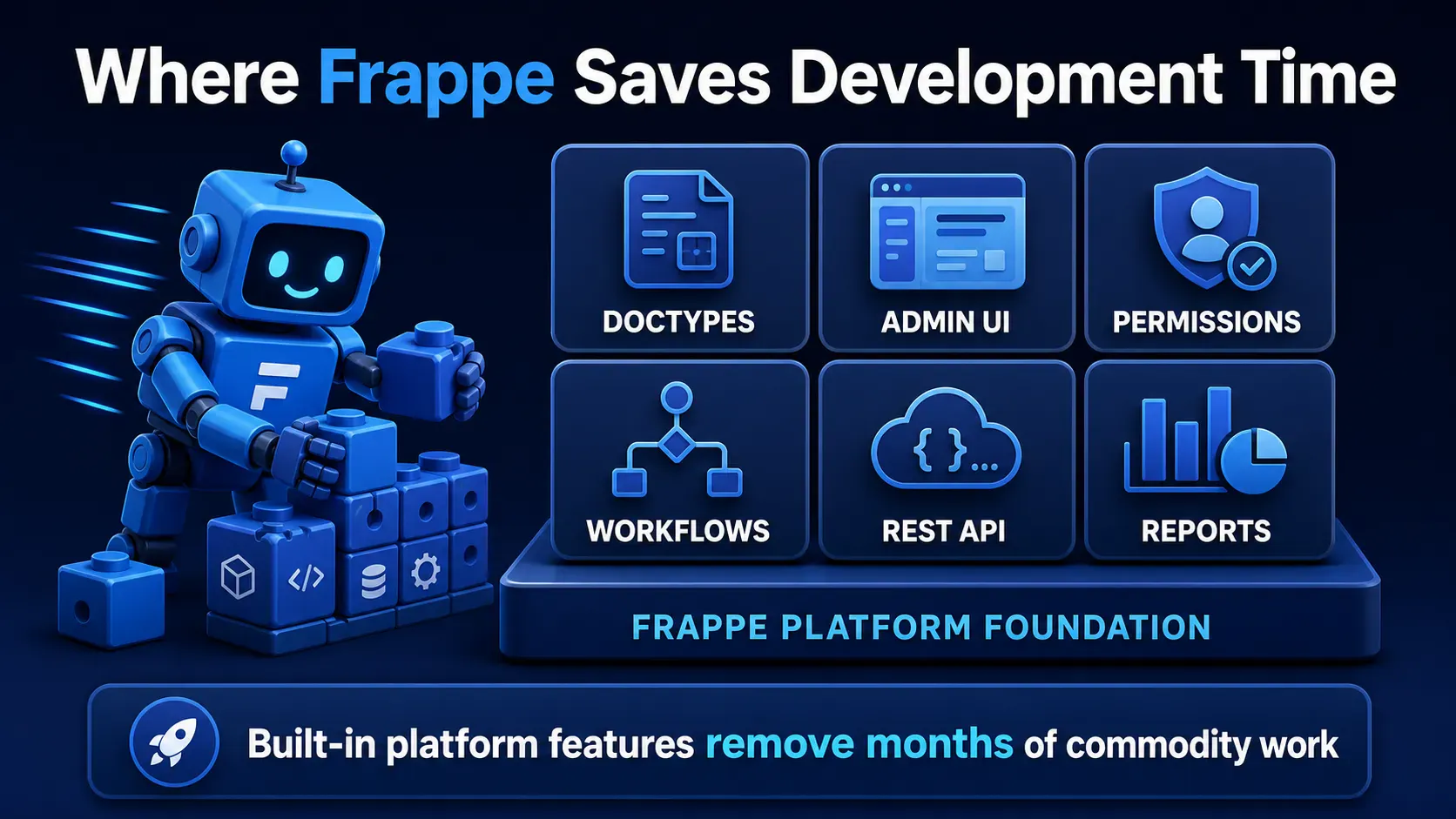
Frappe provides common business-platform capabilities before custom product work begins.
This deserves its own section because it's the actual reason Frappe keeps coming up in these conversations.
Building the same internal tool in a bare framework like Express, plain Django, or plain Laravel means hand-building the admin UI, the API layer, and the permissions system before you've written a line of your business logic. Frappe generates all three the moment you define a DocType.
That head start doesn't just save money once — it compounds 📈. Every new module, every new report, every new workflow reuses the same generated scaffolding instead of needing new boilerplate.
⚠️ Reality Check: This advantage shrinks fast once your app needs a highly custom, non-admin-style UI — think a consumer-facing mobile app or a heavily branded marketing site. Frappe's savings are strongest for internal tools, B2B dashboards, and operations-heavy software.
A handful of variables explain almost all the price variation between two "simple-sounding" Frappe projects.
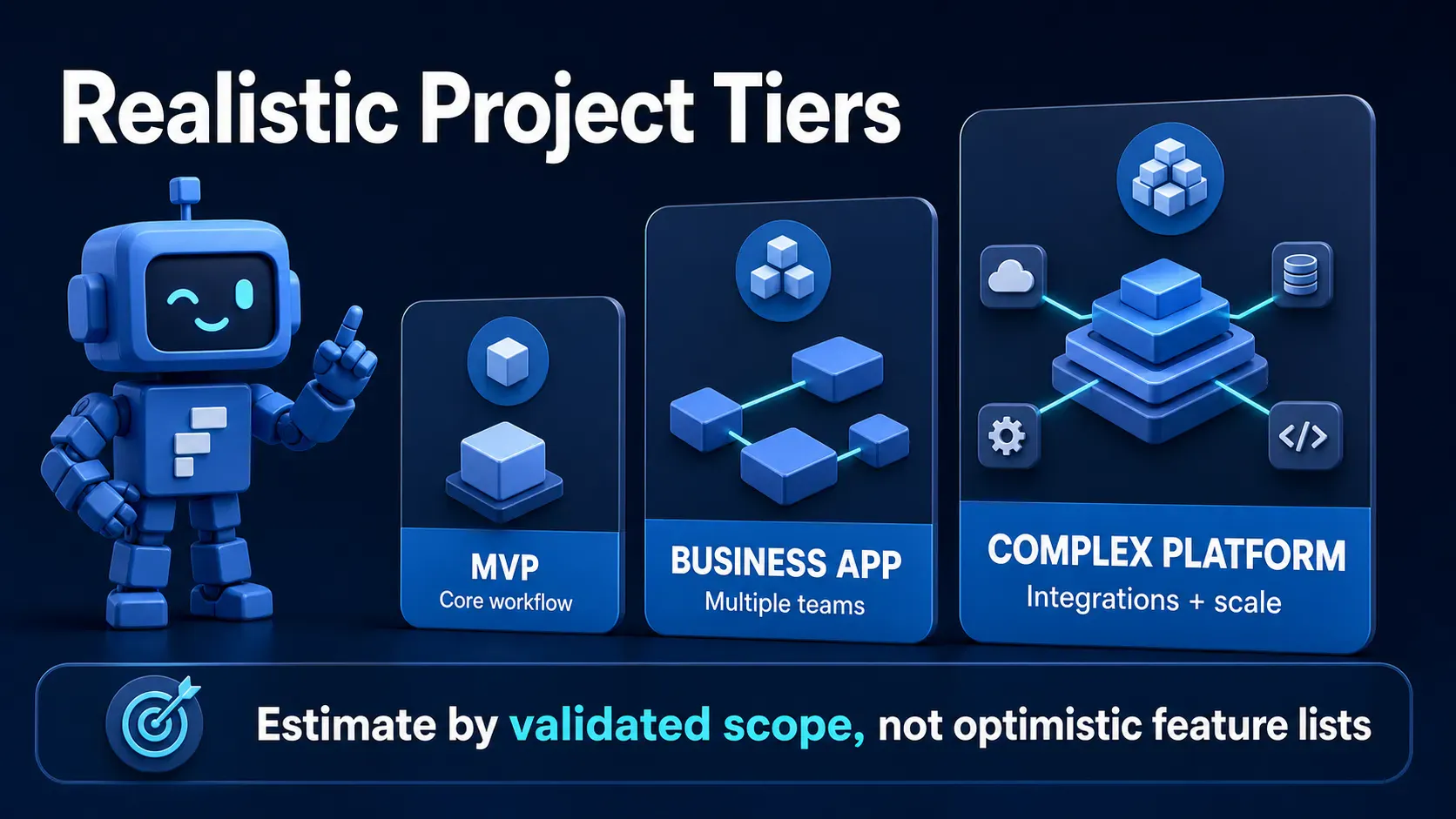
Project tier should reflect validated workflows, users, integrations, and operational complexity.
These figures are rough, illustrative estimates only — actual quotes vary heavily by region, agency, project quality, and scope creep. Treat this as a sanity-check range, never a quote.
| Tier | What It Typically Looks Like | Rough Estimate Range (USD) |
|---|---|---|
| Small internal tool | A handful of DocTypes, basic workflows, minimal integrations, default Desk UI | ~$2,000 – $8,000 |
| Mid-size custom app | 15-30 DocTypes, multi-step workflows, 1-3 integrations (payments, email, etc.), moderate UI customization | ~$8,000 – $30,000 |
| Complex SaaS product / heavy customization | Multi-tenant architecture, custom frontend, many integrations, advanced reporting, significant data migration | ~$30,000 – $100,000+ |
⚠️ Reality Check: These ranges assume reasonably experienced Frappe developers. A cheap quote at the bottom of a range is often missing testing, documentation, or post-launch support — ask what's explicitly excluded before comparing numbers.
Again, treat every number here as a directional estimate, not a current market rate — rates shift with experience level, demand, and currency fluctuations.
| Hiring Path | Typical Rate Range (rough, illustrative) | Notes |
|---|---|---|
| Freelancer, South/Southeast Asia | ~$10 – $30/hour | Widest availability, most price variance; vet portfolios carefully |
| Freelancer, Eastern Europe / Latin America | ~$25 – $60/hour | Often a strong balance of cost and communication overlap |
| Freelancer, US/UK/Western Europe | ~$50 – $120/hour | Smallest Frappe-specific pool at this rate tier |
| Small agency | ~$3,000 – $15,000/month equivalent, project-based | Includes project management, some redundancy if a developer leaves |
| In-house hire (mid-level) | Full-time salary, market-dependent | Best for long-term, evolving products; slowest to hire for |
Frappe's smaller talent pool 🌍 compared to Django or Laravel affects both cost and time-to-hire — expect a longer search and potentially a rate premium for developers with genuine production Frappe experience, especially outside a handful of regions where Frappe/ERPNext adoption is concentrated.
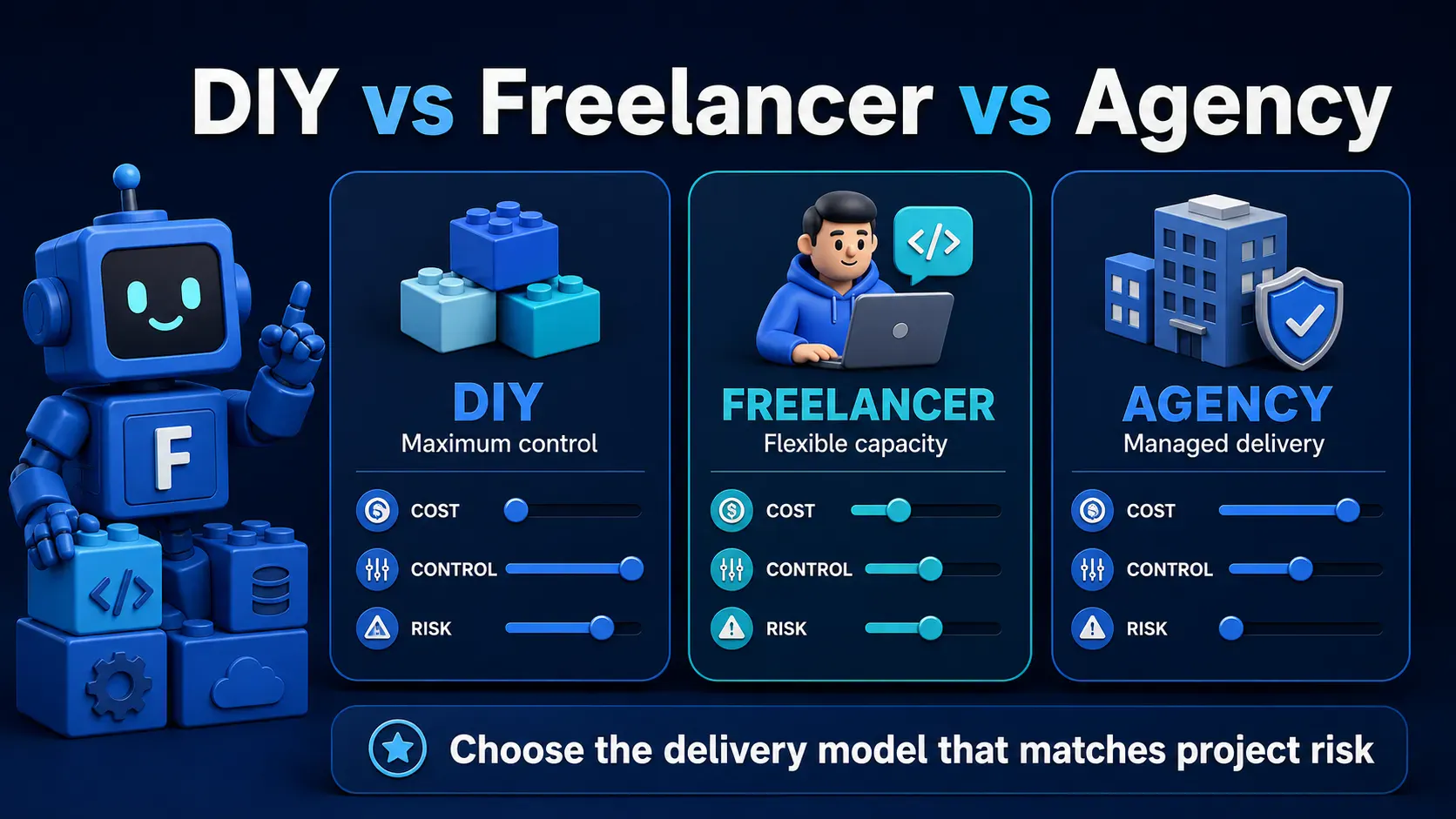
The appropriate delivery model depends on available expertise, control requirements, and project risk.
There's no universally right hiring path ⚖️ — only the one that matches your budget, timeline, and risk tolerance.
| Path | Pros | Cons |
|---|---|---|
| DIY (learn Frappe yourself) | Lowest cash cost; deep product ownership; great for simple internal tools | Steep learning curve; slow for anything beyond basic DocTypes; your time has an opportunity cost |
| Freelancer | Lower rate than agencies; direct communication; flexible for small-to-mid projects | Single point of failure if they disappear; variable quality; you often own project management |
| Agency | Team redundancy; project management included; more likely to have tested processes | Highest cost; sometimes less senior developers actually writing the code; can be slower to start |
💡 Pro Tip: DIY is a genuinely good option if your first app is small and internal — Frappe's own documentation and tutorials are strong enough to get a motivated developer to a working DocType in days, not months.
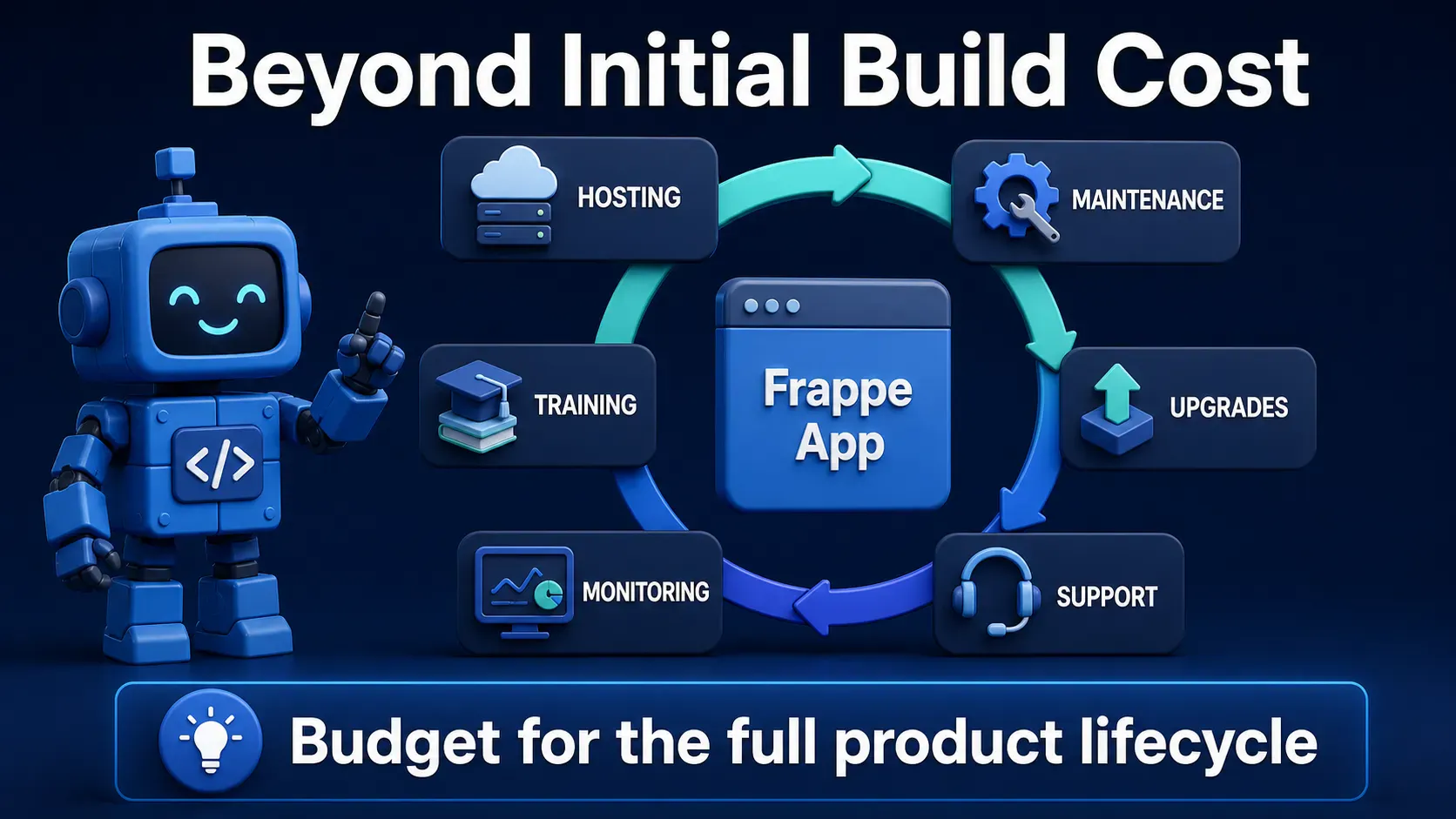
Hosting, maintenance, upgrades, monitoring, support, and training continue after the initial release.
The build cost is only half the budget conversation — three ongoing costs follow every Frappe project.
Hosting 🖥️ is the first, and it varies significantly between a self-managed VPS, managed hosting, and Frappe Cloud. We cover that full cost breakdown, with real numbers and trade-offs, in a dedicated post — treat hosting as a separate line item rather than folding it into your build budget here.
Maintenance and support retainers 🔧 are the second — most teams budget somewhere between 10-20% of the original build cost per year for bug fixes, framework version upgrades, and general upkeep, though this is, again, a rough industry-pattern estimate rather than a fixed rule.
Future feature additions 🌱 are the third and most variable — because Frappe's DocType architecture makes incremental additions relatively cheap compared to bolting features onto a rigid custom codebase, but genuinely new modules still take real developer time.
Watch for these warning signs before signing anything.
Bring this list to your first call — the quality of the answers tells you more than the quote itself.
There's no single dollar figure that fits every Frappe project — only tiers, ranges, and the honest trade-offs behind them. If your app leans admin-heavy and workflow-driven, Frappe's low-code foundation genuinely should cost less to build than starting from scratch. Spend more time scoping DocTypes, integrations, and data migration up front than negotiating the hourly rate 💵 — that's where budgets actually blow up. Walk into your next agency call with this framework, and you'll ask sharper questions than most of their existing clients do. 🎯